
Strategic analysis
Hormuz and the Cloud: When the Sea Teaches Us How to Think About Digital Systems
The parallels between maritime space and digital space are not metaphorical: they are structural. The same dynamics of power, control, asymmetry and dependency are at play.
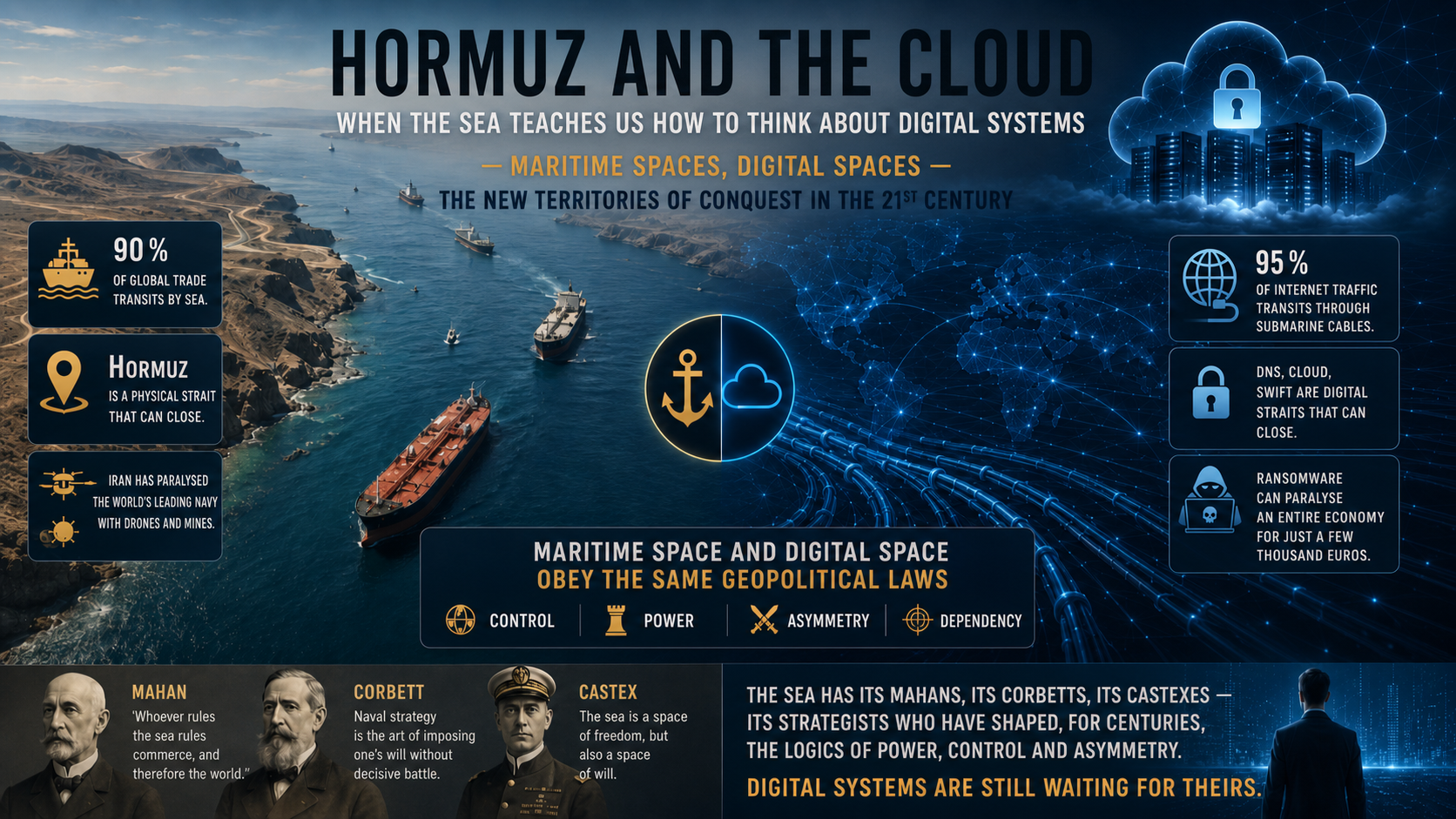
Iran’s closure of the Strait of Hormuz since 28 February 2026 has stunned the world. Within a few weeks, 25% of the planet’s traded oil and 30% of its traded fertilizers stopped circulating normally. The US Navy—the most powerful in the world, with eleven carrier strike groups—proved unable to reopen a strait held by an adversary whose fleet had nevertheless been largely destroyed. The paradox is dizzying.
Ian Speller, a historian of maritime warfare, draws a sharp lesson from this in Le Grand Continent: power without strategy is merely an illusion of strength. Dominating the seas is not enough if one has not first defined why and how to use the means of that domination.
Is this lesson confined to straits and combat fleets?
I do not think so, because what is happening in Hormuz is also happening, simultaneously and far more silently, in digital space: in the ocean depths where submarine cables carry 95% of global internet traffic, in the data centers that concentrate the planet’s computing power, and in the semiconductor architectures whose de facto monopoly is held by a handful of factories in Taiwan. Digital space has its own straits. It has its own blockades. It has its own asymmetric wars.
The sea and cyberspace share the same underlying nature: they are common spaces whose freedom of circulation underpins global prosperity, and in which control over points of constriction—the chokepoints—gives disproportionate power to those who know how to hold them. Mahan, Corbett, and Castex thought about the sea. Their insights apply, with troubling relevance, to Internet architectures, digital sanctions, and swarm cyberattacks.
The ambition of this analysis is precisely to build that bridge: to start from the key ideas of the battle of Hormuz in order to develop a strategic reading grid for contemporary digital issues, and to propose, through comparative reflection, the possible lessons of this troubling symmetry between old territories of conquest and new ones.
The Internet as a Global Sea: An Underestimated Critical Infrastructure
Just as 90% of global trade moves by sea, more than 95% of intercontinental internet traffic travels through submarine cables—a physical, vulnerable infrastructure whose map almost exactly overlaps with the major maritime routes. The cables of Suez and Malacca, and the landing points in the Red Sea, are digital chokepoints just like Hormuz. The cutting of cables in the Red Sea in 2024 was a brutal reminder of this.
A national cyber strategy must articulate ends (what political objectives?), means (technical, diplomatic, and industrial capabilities), and methods (deterrence, resilience, response). Without this, digital power, like naval power, is merely an illusion of strength.
Strategy Must Precede Digital Action
Speller denounces the absence of American strategic planning before the war against Iran. The same criticism can be leveled at many states in the cyber domain: they invest in offensive or defensive capabilities without having defined clear political objectives or doctrines for their use.
A national cyber strategy must articulate ends (what political objectives?), means (technical, diplomatic, and industrial capabilities), and methods (deterrence, resilience, response). Without this, digital power, like naval power, is merely an illusion of strength.
Digital Asymmetry: The Revenge of the Small
The blockade of the Strait of Hormuz shows that a weak power can paralyze a great power by targeting its commercial dependencies. In the digital realm, this is the very principle of asymmetric cyberwarfare: a state or non-state actor with limited resources can disrupt entire economies through ransomware, attacks on critical infrastructure (power grids, hospitals, financial systems), or massive disinformation campaigns.
North Korea, Iran itself, or groups such as Lazarus illustrate this digital “Jeune École”: harass, deny, exhaust—without ever seeking frontal domination.
The major digital powers—the United States, the European Union, and China—cannot ignore the asymmetric denial capacity of weaker actors. The resilience of critical infrastructure must be conceived like coastal defense: in depth, in layers, and by combining civilian and military means.
Digital Chokepoints as Geopolitical Levers
Hormuz is a physical strait. The digital realm has its own bottlenecks: root DNS servers, hyperscaler platforms (AWS, Azure, Google Cloud), semiconductors (TSMC in Taiwan), payment systems (SWIFT, Visa/Mastercard), and app stores (Apple, Google). Whoever controls these nodes can exert devastating economic pressure—as illustrated by digital sanctions against Russia or Huawei.
The conquest of digital spaces depends on mastering these points of constriction. Europe’s digital sovereignty strategy—sovereign cloud, GAIA-X, RISC-V—seeks to respond to this logic: not depending on a single strait that others could close.
Technology as a Factor in Reversing Power Relations
Drone swarms saturating American naval defenses have their equivalent in massive DDoS attacks, botnets, or weaponized generative AI producing deepfakes or large-scale disinformation. The digital weapon offers a considerable force multiplier at low cost: it makes classical deterrence partly ineffective.
The digital technology race is not linear. Today’s superiority—encryption, intrusion detection—may be overturned tomorrow by quantum computing or autonomous offensive AI. A sound strategic posture requires constant technological monitoring and investment in sovereign R&D.
Freedom of Digital Circulation: A Common Good to Defend
As the global economic crisis caused by the closure of the Strait of Hormuz underlines, freedom of navigation at sea remains fundamentally important—a freedom that can be challenged and that must be protected. This formula applies word for word to the freedom of access to the Internet. The fragmentation of the global network—the “splinternet”—is advancing: China’s Great Firewall, Russia’s RuNet, Iranian regulations. Every closure of digital space is the closing of a strait whose effects will ultimately resemble those of the closure of the Strait of Hormuz.
Toward a Strategy of Digital Power: From Awareness to Action
The battle of Hormuz has at least given us this: the brutality of an awakening. When the most powerful naval actor on the planet finds itself powerless against a weakened adversary, something has gone wrong far upstream—in thought, before action. History will remember that in 2026, the United States discovered, at great cost, that possessing force does not dispense with having a strategy.
The digital realm has the same kind of lesson in store for us.
Because, contrary to what a certain techno-optimist way of thinking long led us to believe, the Internet is not a free, neutral, and indestructible space. It is a territory—with borders, mandatory passage points, power relations, dominant actors, and powers of denial. A territory that others began mapping, fortifying, and contesting long before we grasped what was at stake.
So what must be done? Five axes of action stand out.
Map Dependencies as One Maps Coastal Vulnerabilities
Every strategy begins with a clear-eyed diagnosis. States, companies, and organizations must conduct a systematic audit of their critical digital dependencies: which cloud providers? Which submarine cables? Which payment systems? Which hardware components? How much of their operational sovereignty is concentrated in the hands of foreign actors that could become chokepoints under geopolitical pressure? Without this mapping, one sails blind—and discovers Hormuz the day it closes.
Invest in Resilience Infrastructure, Not Performance Alone
The temptation to optimize digital systems for performance and cost is strong. This is exactly the reasoning that led to concentrating global semiconductor production in a few Taiwanese plants, the world’s data in three American hyperscalers, and intercontinental cabling along a handful of vulnerable routes. Resilience has a cost—redundancy, diversification, partial sovereignty—but it is the price of freedom of action in times of crisis. Europe, with its sovereign cloud projects, alternative transatlantic cables, and semiconductor initiatives, has begun this shift. It must be radically accelerated.
Think in Terms of Digital Deterrence, Not Defense Alone
Corbett and Mahan did not think only about coastal protection: they thought about the ability to project power and impose costs on the adversary. A true strategy of digital power cannot be limited to passive cyber defense. It requires developing—and signaling—credible offensive capabilities, a clear attribution doctrine, and mechanisms for proportionate retaliation. Digital deterrence is not war: it is precisely what makes it possible to avoid it. Democracies have hesitated for too long to embrace this dimension of their power.
Build Digital Alliances Before They Are Needed
One of the most striking images of the Hormuz crisis is that of Donald Trump calling on his allies—and China—to form a naval coalition at the last minute. The mistake is not needing allies; it is only thinking of them at the moment of crisis. Digital alliances—system interoperability, cyber intelligence sharing, common Internet governance standards, agreements to protect submarine cables—are built in peacetime, through trust and reciprocity. They must be developed with the same strategic priority as traditional military alliances.
Train Strategists, Not Just Technicians
The deepest lesson of Ian Speller’s article is not technological. It is human: the absence of strategists capable of thinking in terms of ends, means, and methods—before acting. The digital realm suffers from the same deficit. It trains excellent engineers, talented developers, and competent cybersecurity experts. It trains too few thinkers capable of articulating technology with geopolitics, economics, international law, and political philosophy. Yet it is from this synthesis that great strategies are born. Mahan was a historian before he was an admiral. Tomorrow’s digital decision-makers will also need to be able to read Thucydides as well as understand a TCP/IP protocol.
The history of common spaces—the sea, the air, outer space—always follows the same trajectory: first a space of freedom and exploration, then a space of trade and interdependence, and finally a space of competition, conflict, and power relations. The Internet moved through the first two phases at dizzying speed. It is now resolutely entering the third.
The question is no longer whether digital space will become a territory of conquest. It already is. The only question that now matters is who will have the lucidity, the will, and the method to build real power there—before others close the strait. 05 — Pre-import Check