
Strategic analysis
Starlink Mobile: From Ambition to Execution
SpaceX’s roadmap turns its mobile ambition into an execution challenge: orbital capacity, terrestrial integration and reliable service continuity.
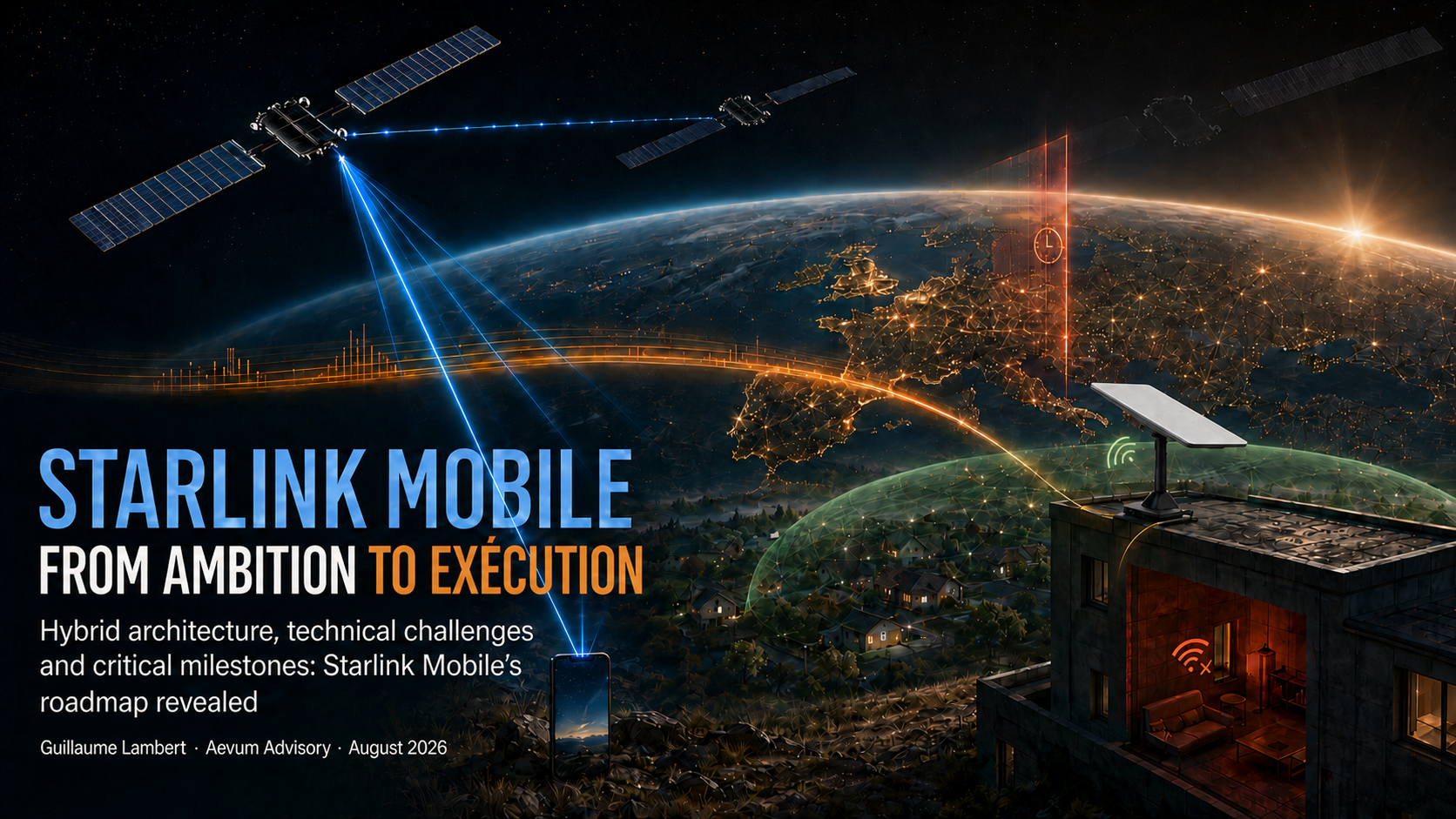
On August 4, 2026, SpaceX held its first public earnings conference from its Bastrop, Texas site since its IPO on June 12. Elon Musk, Gwynne Shotwell, and Bret Johnsen detailed spectacular financial results ($7.8 billion in quarterly revenue, up 92% year over year), as well as the roadmap for their strategy to develop a mobile communications network combining terrestrial and space-based stations.
In less than an hour of discussion, SpaceX turned what was still, six weeks ago, an ambition announced during its IPO into a public, dated, quantified, and technically detailed commitment.
This ambitious operational program, which nevertheless includes many unresolved technical challenges, confirms the firm intention to transform Starlink into a true hybrid mobile network capable of competing with traditional terrestrial mobile operators.
A locked-in timetable targeting the launch of mobile services as early as 2027 through a revolutionary hybrid architecture
During the presentation of its latest financial results, Gwynne Shotwell, SpaceX’s president, confirmed a particularly aggressive strategy to gain market share in the mobile communications sector as early as 2027.
In particular, responding to UBS analyst John Hodulik, Gwynne Shotwell stated: “We will begin launching the next-generation mobile satellites next year, and we will begin providing service at the end of next year.” The plan therefore calls for the operational deployment of V2 communications satellites in orbit in 2027 and the launch of the commercial Starlink Mobile service at the end of 2027.
At the same time, SpaceX intends to leverage the 65 megahertz of wireless spectrum acquired from EchoStar under agreements totaling $19.6 billion, giving it the terrestrial rights needed to operate as a true carrier rather than merely as a satellite backup solution.
Starlink’s target architecture is therefore hybrid: Starlink satellites filling rural coverage gaps, paired with terrestrial relay antennas in high-density areas. Gwynne Shotwell indicated that the service would begin at the end of 2027, with a network potentially 100 times more powerful than the current direct-to-phone offering, which relies on “about 5 MHz of bandwidth through local operators.”
The terrestrial strategy revealed: the return of the femtocell
This was the newest and most structurally important element of the conference for understanding how SpaceX intends to solve the terrestrial network equation without relying on the three major mobile network operators in the United States, but also without massive Capex and without additional spectrum auctions.
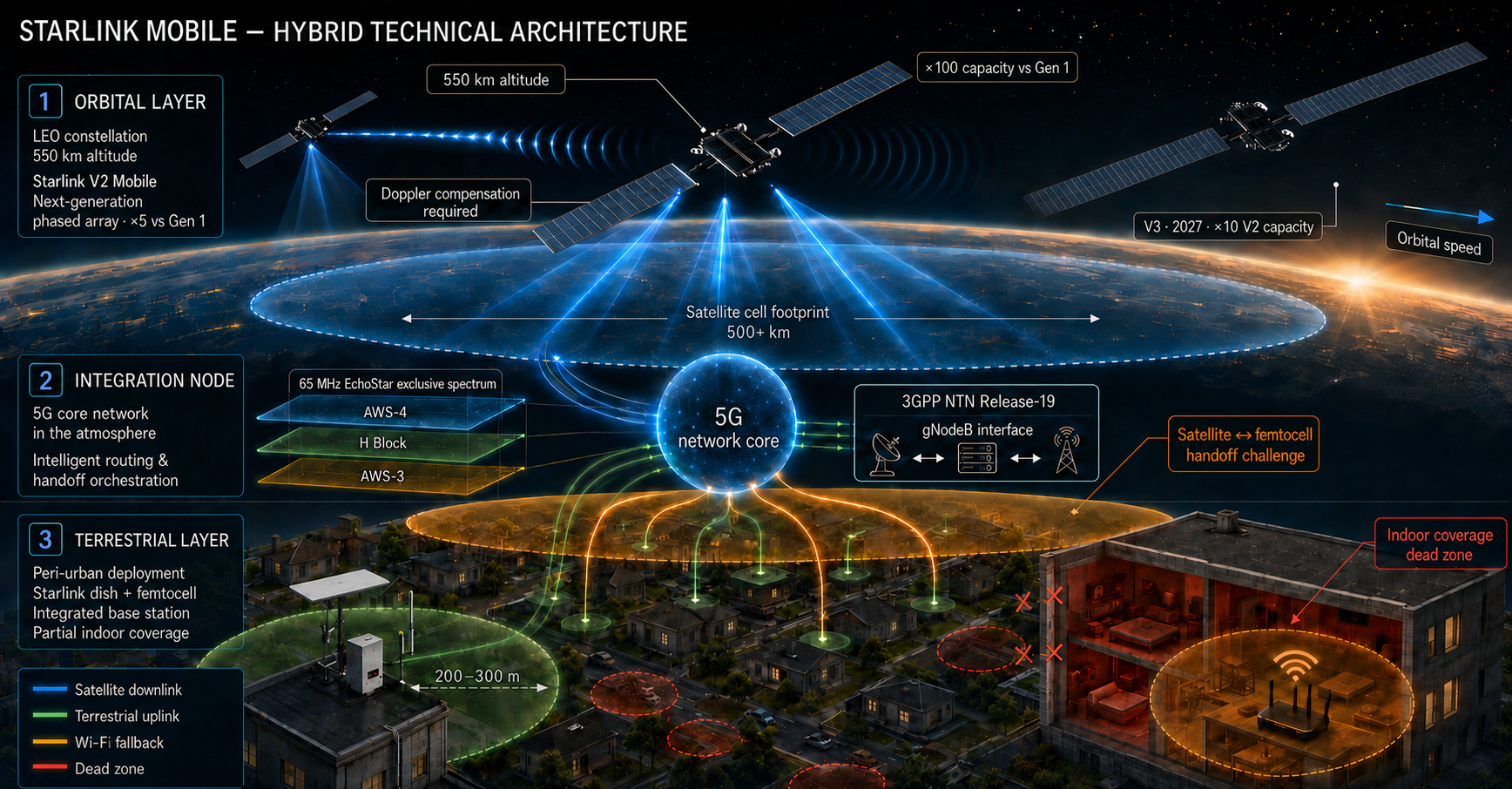
A novel hybrid technical architecture
Responding to Kutgun Maral of Evercore ISI, SpaceX’s president lifted part of the veil: “The spectrum acquired from EchoStar has terrestrial components. We fully intend to develop that terrestrial component. We could put a cellular base station on the mount that holds the Starlink broadband antenna. We can have these small femtocells across the country and deploy them as needed. There is no need to spend billions of dollars on low-band spectrum upfront.” Elon Musk added: “Instead of having to deploy these large cellular base stations that are very expensive and difficult to site, we are reasonably confident in our ability to deploy a large number of small stations — essentially Starlink antennas located on the roofs of homes and businesses, providing connectivity directly to mobile phones — probably better and with higher bandwidth than what is currently available from cellular operators.”
SpaceX already has several million Starlink antennas installed on rooftops in the United States. Each becomes a potential terrestrial point of presence, without site acquisition or negotiations with tower owners. These compact relays could emit a local signal to provide nearby cellular connectivity, with the Starlink antenna providing the backhaul link to the internet via the satellite constellation.
This renewed interest in femtocell technology had in fact been central to some discussions at MWC 2026 in Barcelona: these small, self-installable base stations, whose new generations, supported by integrated baseband platforms and Open RAN ecosystems, enable coverage and network densification at costs far below those of traditional macro-cellular deployments.
An element revealed after the Q2 conference further reinforces the logic of this strategy and clarifies its ambition: SpaceX is considering deploying its femtocells not only on residential Starlink antennas, but also on Tesla Supercharger stations (about 3,000 stations in the United States located along roadways and in peri-urban areas) and potentially on future Cybercabs. This SpaceX-Tesla vertical integration turns the entire Tesla fleet into passive network infrastructure, with no site acquisition cost, and partly addresses the criticism of “Swiss cheese” coverage by adding points of presence along major transit corridors.
But this strategy faces real and documented technical obstacles.
The 3GPP wall and physical constraints: major challenges to solve
The wording Elon Musk used during the Q2 2026 conference, saying that he and his teams were “reasonably confident,” deserves scrutiny. In 2017, he was “fairly confident” that Starship would be ready to launch within five years. It took seven. Caution is warranted when assessing SpaceX schedule projections on engineering topics as complex as building an entirely unprecedented hybrid terrestrial-space mobile network.
The physical constraints of low Earth orbit
Even before addressing standardization challenges, the proposed hybrid architecture faces limits inherent in the physics of satellite communications in low Earth orbit. A LEO satellite at an altitude of 550 km serves a ground cell several hundred kilometers in diameter. This geometry mechanically imposes a much lower spectral density per user than a terrestrial cell covering a few hundred meters.
There is also the management of Doppler shift. A satellite in low Earth orbit travels at about 7.5 km/s, generating significant frequency variations (several kHz) that the receiver — the smartphone — must compensate for in real time. 3GPP NTN specifications include satellite-side Doppler pre-compensation mechanisms, but implementing them in existing terminal chipsets remains a non-trivial engineering challenge. Satellite-ground round-trip latency is structurally higher than that of a terrestrial network (between 25 and 40 ms for a 550 km orbit, compared with less than 10 ms for a terrestrial 5G cell), which may affect the proper operation of certain real-time applications.
Finally, indoor coverage is absent by design in the rooftop-femtocell model. A Starlink antenna on a roof does not penetrate the walls of a building. Wi-Fi offload can partially compensate, but only where roaming agreements are in place and where Wi-Fi exists.
The 3GPP wall: a complete network stack to build
For a standard smartphone, without hardware or software modification, to connect to the Starlink Mobile network, SpaceX must build a network stack fully compliant with 3GPP specifications. SpaceX announced at MWC 2026 that Starlink Mobile will use the 3GPP Release 19 NR-NTN standard, the most recent and ambitious version of the specifications for non-terrestrial networks. However, three major implementation challenges remain unresolved.
First challenge: updating the device base. The NR-NTN Release 19 standard is not backward-compatible with all existing devices. SpaceX is actively working with device and modem manufacturers to ensure broad compatibility, but in practical terms this means that smartphones currently in circulation will not automatically be compatible. Firmware updates are required for recent devices, and older phones that cannot update the NTN layer will remain excluded from the service. Only about sixty models are currently compatible with the Gen 1 D2C service, a number that will need to grow massively for Starlink Mobile to achieve meaningful commercial reach.
Second challenge: the 5G core network. 3GPP compatibility is not limited to the radio interface. It requires full integration between the satellite access network, terrestrial femtocells, and a 5G Core compliant with 3GPP SA specifications. The 3GPP NTN architecture, as defined in specifications TR 38.821, TS 38.101-5, and TS 38.104, imposes precise adaptations for LEO orbits, particularly for Doppler compensation, timing, mobility procedures, and spectral band mappings. SpaceX will have to build or acquire this core network infrastructure. Open RAN, which pursues a similar objective of disaggregation, remains difficult to deploy at scale despite years of intense industry effort. The complete network stack represents a multi-year engineering program, not a software deployment of a few months.
Third challenge: inter-cell coordination and mobility management. A hybrid network combining moving satellite cells (traveling at 7.5 km/s) and fixed terrestrial femtocells raises unprecedented issues in managing handovers — service continuity when moving from one cell to another. A smartphone must switch in real time between a moving satellite cell and a fixed terrestrial femtocell without a perceptible interruption. Both D2C and 3GPP NTN paradigms require precise adaptations for Doppler and timing management in LEO orbits, and their coexistence in a large-scale hybrid satellite-femtocell network has not yet been commercially demonstrated.
Are these obstacles insurmountable? No. Can they be solved by the end of 2027? That is exactly the question seasoned telecom analysts are asking with skepticism. Craig Moffett (MoffettNathanson) believes that without an MVNO agreement with an established operator, it is “extraordinarily difficult to imagine a Starlink direct-to-consumer service competitive with operators’ offerings in the next five years.” David Barden (New Street Research) emphasizes that it “does not make sense to try to replicate with 65 MHz what terrestrial operators have built over thirty years with about 1,000 MHz.”
Dimitris Mavrakis, senior research director at ABI Research, goes further: “The industry has already concluded that femtocells are not a viable primary deployment model, even for established operators. The difficulty is not only connecting the cells together — it is getting power to the right places and finding optimal locations, not to mention the economics and return on investment.” Roger Entner, founder of Recon Analytics, points to an often overlooked dimension: beyond the technical challenges, SpaceX will have to build its entire commercial infrastructure from scratch — billing systems, retail distribution channels, customer service operations, and device compatibility. These are assets that AT&T, Verizon, and T-Mobile took thirty years to build and that SpaceX’s financial power cannot instantly replace.
These objections are based on conventional network deployment rules. SpaceX is not building a conventional network. It is attempting an unprecedented hybrid architecture whose closest precedent is Starship itself: solving what the industry considered technically out of reach within the announced timeframe.
The European front: a position that holds, under growing pressure
Since the ultimatum contained in SpaceX’s white paper, the European Commission has not yielded. The proposal of May 27, 2026, is following the ordinary legislative path, which should lead to its adoption by the European Parliament and the Council. The Commission’s budget timetable suggests adoption in late 2027 or 2028, a selection procedure in 2028-2029, and the allocation of new rights in 2029.
But Europe’s resistance is more fragile than it appears. Internally, Digital Commissioner Henna Virkkunen argued for a measured opening, concerned not to ignite a new trade front with the Trump administration, while Defense Commissioner Andrius Kubilius defended full reservation for European champions only. The two-thirds compromise precisely reflects this internal political arbitration, and it remains fragile, exposed to cross-pressures from Washington and from Member States with diverging interests.
The FCC’s reciprocity threat has not been withdrawn. Its chairman, Brendan Carr, warned that any discrimination against a U.S. operator would trigger aggressive measures that could exclude European companies (Inmarsat, Eutelsat) from the U.S. market. It hangs over every stage of the legislative process.
One important procedural fact should be recalled. The Commission formally prohibited the automatic transfer of EchoStar’s European licenses to SpaceX as part of the U.S. transaction. SpaceX will therefore have to participate in the 2028-2029 selection procedure like any other candidate, within the framework Brussels is now defining. This is precisely why SpaceX’s white paper should probably be understood as an attempt to influence the drafting of that framework before it is locked in, rather than as a reaction to a decision already taken.
Five major European operator groups (CK Hutchison, Orange, Sunrise, Telefonica, and Vodafone) have already signed agreements to deploy satellite D2D services in Europe, with customer trials planned for summer 2026. These operators are integrating Starlink into their residual coverage architectures at the very moment the Commission is deliberating on the spectrum framework. And the distribution agreement being considered with Charter Communications faces a legal constraint identified by BNP Paribas analysts: the existing MVNO contract between Charter and Verizon could contain clauses preventing Charter from reselling that access to SpaceX. What SpaceX presented as its main workaround to the refusal of the three major U.S. mobile network operators to sign an MVNO agreement with Starlink is therefore itself potentially blocked, at least in its initial form.
In my analysis published on June 29, I wrote that the decision on the 2 GHz band would be made before IRIS² becomes operational. The European selection procedure for future rights holders will not be completed before 2028-2029. Europe will decide on spectrum allocation while Starlink Mobile is already in service at the end of 2027 in the United States and with its international partners, SoftBank, NTT Docomo, and Spark New Zealand, announced during the Q2 conference. This is the scenario of recomposition through usage that is beginning — not head-on, but by capillary spread.
In conclusion, here are the milestones to watch in the coming months to determine whether the announced roadmap for Starlink Mobile holds.
SpaceX’s Q2 conference turns the Starlink Mobile file into an operational program whose first deliverables (satellites in orbit, signed partnerships, commercial service) should be visible before the European procedure for allocating the 2 GHz band is completed. However, the technical obstacles are real and documented, some commercial constraints appear underestimated, and the roadmap includes several risky assumptions.
Six milestones will make it possible to verify, over the next eighteen months, whether the strategy announced by Elon Musk and Gwynne Shotwell materializes.
The mass deployment of V3 satellites via Starship.
An initial validation deployment took place on July 24, 2026: Starship Flight 13 placed 20 operational V3 satellites into orbit, marking the first time a next-generation payload had reached orbit from the Starship platform. But this initial deployment is not yet at commercial scale. The real milestone is Starship Flight 14, scheduled for late August 2026, which is expected to begin mass deployment of V3s. Falcon 9 continues to handle V2 Mini deployments to maintain current coverage (29 new satellites were launched on August 12, 2026), but it cannot carry full-size V3s, whose mass and volume require Starship. Without V3 satellites in orbit at scale, there is no 100x capacity, and the end-2027 service timetable slips accordingly. The success or failure of the tower catch on Flight 14 is a direct signal of the deployment cadence to come.
The announcement of U.S.
distribution partners. During the Q2 conference, Shotwell referred to very exciting announcements to come, perhaps as early as today. The Charter file is weakened by MVNO clauses with Verizon. Who will sign with SpaceX, on what terms, and on what timeline? An agreement announced before the end of 2026 would be a strong signal of the project’s commercial credibility.
The launch of full-size Mobile V2 satellites.
It is important to distinguish the current generation from the next one. More than 650 V2 Mini Direct-to-Cell satellites are already in orbit and provide basic text and data service through T-Mobile and its partners, but at speeds of a few hundred kilobits per second, far from a standard cellular service. The true Mobile V2 satellites, too large for the Falcon 9 fairing, will begin launching via Starship from mid-2027, with the ambition of an operational constellation of 1,200 units within six months of the first launch. This generation, not the current V2 Minis, determines the commercial service announced for the end of 2027. The schedule therefore depends entirely on Starship’s ramp-up. Confirmation that the first full-size V2s are in orbit before Q2 2027 would validate the trajectory. Any delay mechanically pushes back commercial service.
Announcements on the deployment of terrestrial femtocells.
SpaceX has disclosed neither dates, volumes, nor Capex for this component. No date has been announced for the deployment of terrestrial femtocells, nor for any commercial launch outside the United States. If Shotwell was deliberately elliptical about Capex, it is probably because the figures have not yet been finalized. Communication by the end of 2026 on the target deployment volume, pilot sites (Tesla Superchargers?), and associated Capex would be a sign of the plan’s maturity.
Progress in device compatibility.
The NR-NTN Release 19 standard requires active collaboration with chipset manufacturers (Qualcomm, MediaTek) and smartphone makers (Apple, Samsung). The number of compatible models — about sixty today for Gen 1 — will need to increase by an order of magnitude. Announcements of chipset partnerships or OS integration (iOS, Android) by the end of 2026 or early 2027 will be decisive. Their absence would indicate a structural delay on this front.
The Q3 2026 results (November) and the terrestrial Capex trajectory.
CFO Bret Johnsen indicated that total Capex will remain close to $18.4 billion per quarter over the next two quarters. If a “mobile terrestrial network” line appears in the Q3 or Q4 Capex breakdown, it will be the first quantified confirmation that femtocell deployment has moved from concept to budgeted program. Its absence, by contrast, would signal that the project is still at the study stage.