
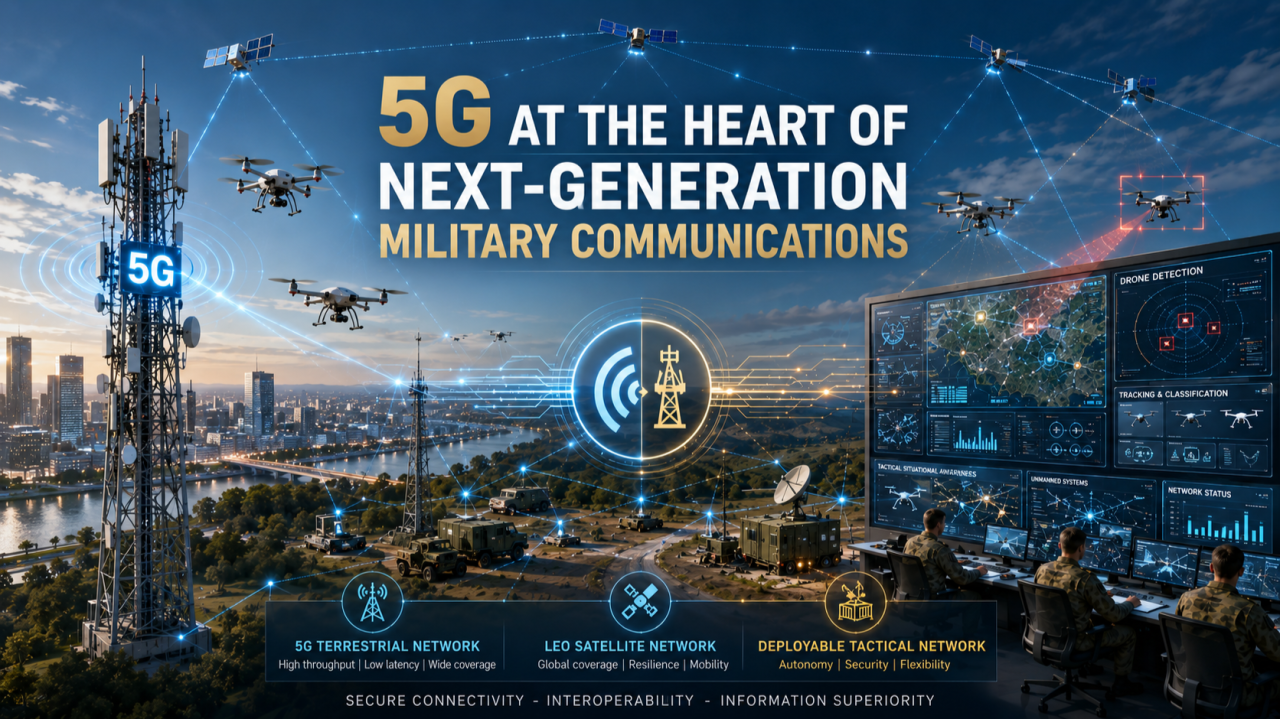
For decades, armed forces communicated over their own networks: proprietary, siloed, costly to maintain and difficult to evolve. That logic is now being reversed.
NATO has identified next-generation communication networks, including 5G, as one of nine emerging and disruptive technologies that present new opportunities and new threats to Allied security.
As industry did before it, and as health and public-safety sectors did before it, defence is shifting towards the open standards of commercial mobile networks — 4G, 5G and, eventually, 6G. This shift is one of the most significant structural changes in the B2B telecommunications market for the decade ahead.
At the 2025 Hague Summit, NATO Allies committed to invest 5% of GDP in defence and security expenditure by 2035. Of this total, 1.5% of GDP is earmarked for defence-related critical infrastructure, including cybersecurity, communication networks and civil resilience. European NATO members’ ICT investments in aerospace and defence already exceeded 11 billion dollars in 2025, and are on a sharply accelerating trajectory.
Non-negotiable security requirements for military use of 5G
Mobile networks were not designed for military uses. Their security standards do not cover every element of the network and provide only a baseline. To qualify as “defence ready”, a 5G network must meet a body of requirements that goes well beyond commercial compliance.
The first level of these requirements is the ability to verify the supply chain of 5G network components. If civilian or military 5G networks were compromised or came under the control of potential adversaries, the consequences for NATO’s military instrument — and therefore for deterrence and defence — would be catastrophic. This is why NATO has incorporated reliability criteria into its security policies and procurement procedures, with particular attention to high-risk vendors.
The second level of requirements is the Zero Trust architecture. The Zero Trust Data Format (ZTDF), ratified by NATO’s Combined Communications-Electronics Board as an interoperable standard for cross-border use, extends Zero Trust principles to the file itself: each piece of data carries its own encryption, access rights and traceability, independently of the network through which it travels. It is no longer network security that protects the data; the data protects itself.
The third level is the management of electromagnetic risks. Rogue cell towers, compromised terminals and the geolocation of devices in operation are real risks for any military operation using 5G. Dynamic spectrum sharing and the ability to pivot rapidly between frequency bands are among the available responses. NATO is working to incorporate these electronic-protection measures into the next generation of its STANAG 5665 standard.
The fourth level of requirements is the ability of 5G networks to carry end-to-end encrypted information and to enable secure interconnections between networks so that NATO personnel can roam from one network to another. NATO’s CCDCOE (Cooperative Cyber Defence Centre of Excellence), based in Tallinn, Estonia, has validated Oracle’s Security Edge Protection Proxy (SEPP), deployed on a Druid 5G Raemis core via Oracle Roving Edge Devices, as a trust mechanism for securing roaming communications between member-nation networks, with encryption in transit and at rest.
Military employment of 5G will combine public, private and non-terrestrial networks
Building a fully military, full-stack private 5G network would present major drawbacks: high initial and maintenance costs, limited coverage and the obligation to use dedicated frequencies. By contrast, relying on components of commercial 5G networks in combination with private 5G networks reduces costs and offers much broader coverage. The answer is therefore not binary — proprietary network or public network — but hybrid and multi-layered.
The emerging reference architecture for next-generation military mobile networks is organised around three complementary layers.
Commercial public network
The commercial public network forms the base layer: it provides coverage, capacity and economies of scale. Quality-of-service, priority and pre-emption mechanisms — such as those deployed in France’s Réseau Radio du Futur — guarantee access for military users even when the network is saturated.
Deployable private networks
Deployable private 5G networks, or “tactical bubbles”, form the operational layer closest to the force. Solutions such as Nokia’s Banshee, already used by the US Marine Corps and at NATO’s Ādaži base in Latvia, can rapidly deploy a private 5G/LTE network in austere conditions, with network-slice isolation, co-located edge computing and interoperability between national and coalition forces.
Non-terrestrial networks
Non-terrestrial networks (NTN) made up of LEO, MEO or GEO satellites, or HAPS drones, provide the resilience and extended-coverage layer. They now form an integral part of the 5G ecosystem, ensuring dynamic interoperability, secure routing and mission continuity across the ground-to-space continuum.
The NATO REPMUS exercise in Portugal demonstrated that a mobile 5G bubble can extend the operational reach of unmanned maritime systems from 10 to 30 kilometres between 2023 and 2025.
Tactical 5G networks also address the requirement for electromagnetic discretion. Operating in the 24–29 GHz band, a 5G mmWave tactical bubble creates a temporary local network that natively offers Low Probability of Intercept (LPI) and Low Probability of Detection (LPD) capabilities. High-bandwidth connectivity remains robust against electromagnetic interference and jamming attempts. The limited range inherent in mmWave — from a few hundred metres to a few kilometres — is not a weakness in this context. It is precisely what gives the bubble its discretion: a high-frequency directional beam, naturally constrained by atmospheric propagation and difficult for distant sensors to intercept. The range constraint becomes a security attribute. This is demonstrated by Microamp’s solution, which integrates Anduril Industries’ ruggedised VoyagerVM server and Druid Software’s Raemis network core, presented at MILCOM 2025 and MWC Barcelona 2026.
In the event of a collapse of terrestrial infrastructure, a 5G NTN constellation integrating an on-board core becomes both a base station and a network core, keeping critical communications active for civilian, emergency and military uses without depending on ground power supplies. This is the architecture the US DoD is exploring with Starshield, and which Telefónica tested in 2025 aboard a NATO Standing Naval Forces vessel.
NATO armed forces’ communications planning, based on the PACE approach (Primary, Alternate, Contingency, Emergency), is being redefined: 5G is intended to move from a contingency option to a primary option, with HF, VHF and UHF networks retained as backups.
Key takeaway
In a contested environment, 5G is not a replacement for every military network. It is the orchestration layer that makes public, private and non-terrestrial capabilities work together.
The central role of 5G in transforming C2 command centres into C4ISR
As the battlefield becomes digital, the ability to command and control in real time has become a decisive factor for success. It is in this context that the concept of C4ISR — Command, Control, Communications, Computers, Intelligence, Surveillance and Reconnaissance — was developed to describe the most modern form of command centre. Such an architecture is the nervous system of military operations: it is designed to collect massive volumes of data from multiple sensors, databases and other global sources, process them and share them with authorised users for better-informed decision-making. 5G is its vascular system: it is what makes C4ISR operational.
5G integrated into DoD operations supports CJADC2 (Combined Joint All-Domain Command and Control) by ensuring seamless communication between platforms operating across land, maritime, air, space and cyber domains. Network slicing enables virtual networks to be prioritised according to mission-critical applications, with dynamic and secure allocation of resources.
In practical terms, 5G transforms command-centre functions along three axes, enabling their architectural evolution from C2 (command and control) to C4ISR.
- Very high 5G data rates facilitate the download of large sensor data sets — for example, data transfer between operators and autonomous vehicles — and enable real-time multi-domain data fusion. An operations centre can simultaneously ingest drone video feeds, force-location data, alerts from IoT sensors deployed in theatre and intelligence databases into a unified dashboard, with sub-second latency.
- 5G also supports the development of command autonomy at the edge because its high data throughput catalyses the various components of autonomy: platform autonomy, collaborative autonomy between platforms and domains, and mission autonomy, where an operator can assign an objective to a platform and allow it to act. Combining mission autonomy with PACE plans embedded in each UAV or unmanned vessel, integrating 5G communications, a MANET mesh network and 5G NTN satellite access, ensures continuity of command across a very broad spectrum of combat conditions.
- Finally, 5G enables embedded artificial intelligence at the network edge. The future of C4ISR architectures will be defined by systems that learn, adapt and coordinate in near real time across multiple domains. Deep-learning algorithms rapidly analyse ISR feeds, identify anomalies and suggest courses of action. 5G with co-located edge computing is the sine qua non for running those algorithms close to the action, without depending on connectivity to a remote cloud.
In conclusion: defence 5G, the next major B2B telecom market, open only to qualified operators
The defence 5G communications market will not open to every operator. “Defence-ready” qualification requires supply-chain sovereignty, a validated Zero Trust architecture and the ability to operate in degraded or contested environments. Operators whose networks include equipment from high-risk suppliers are likely to be excluded. Above all, it is a market of trust even more than of performance.
What the RRF has built for public-safety and emergency actors in France — a state-operated network core, open 3GPP standards, priority and pre-emption mechanisms, and a path towards 5G SA — is precisely the model allied armed forces are watching with increasing interest. Public safety has shown the way. Defence is now taking it.