Strategic analysis
Hormuz, Act II: when Iran simultaneously threatens ships and submarine cables
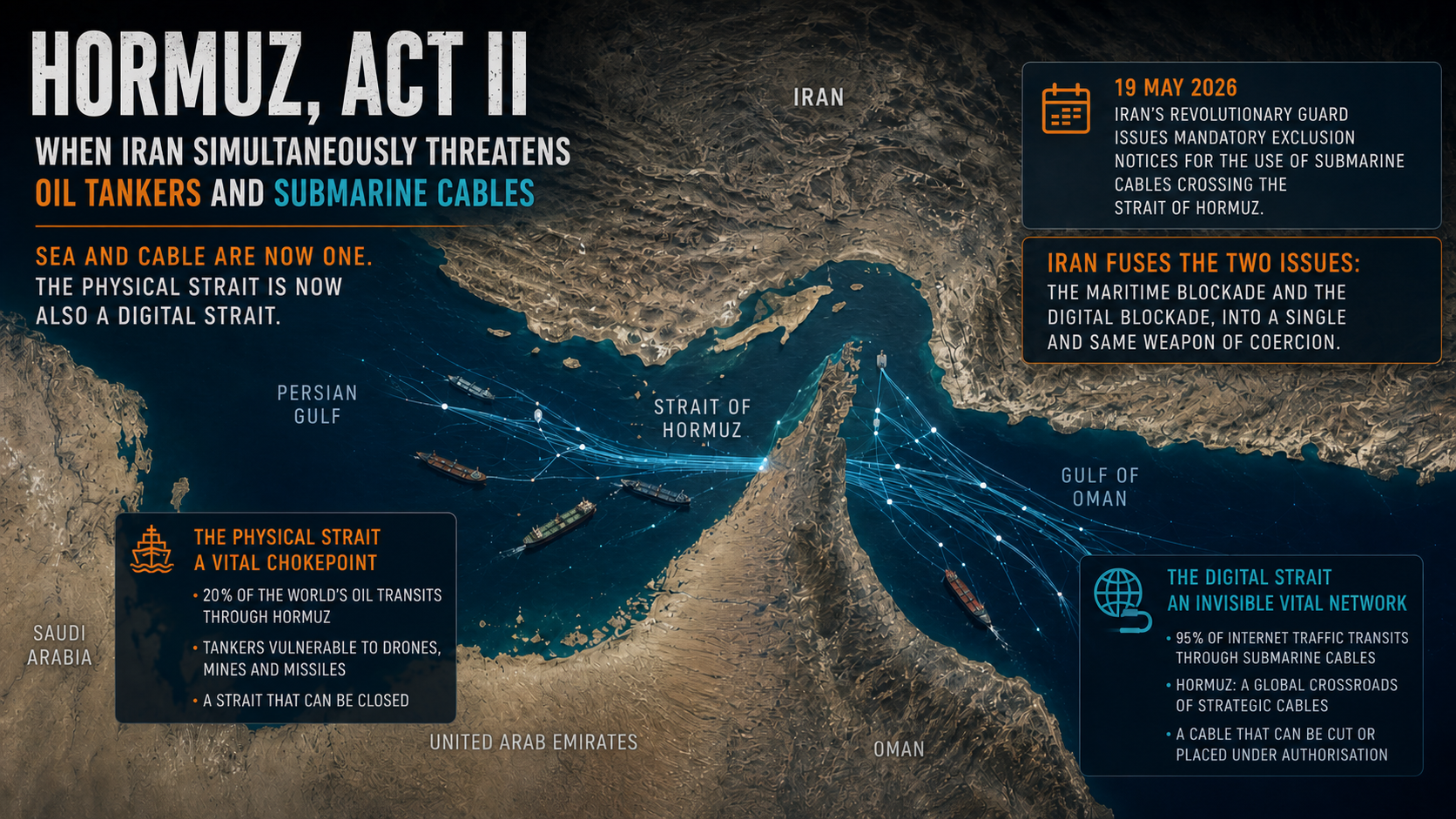
In my previous article, I compared maritime spaces and digital spaces as two territories governed by the same logics of power, control, and asymmetry. This analogy is not merely speculative, as shown by the pressure Iran is now exerting not only on maritime traffic but also on the submarine cables crossing the Strait of Hormuz.
On 19 May 2026, Iran’s Revolutionary Guards went one step further by threatening to introduce mandatory “permits” for the use of submarine cables crossing the Strait of Hormuz. Maritime blockade and digital blockade are thus converging into a single instrument of coercion.
The sea and the fiber-optic cables laid on its seabed have become one and the same: the physical strait and the digital strait are merging.
What passes along the seabed of the strait
To understand the significance of this threat, we must first measure what actually passes beneath the waters of Hormuz.
A section of the AAE-1 submarine cable (Asia, Africa, Europe)[i], a vast submarine infrastructure linking Hong Kong to Italy and France, passes through the Strait of Hormuz. The FALCON and Gulf Bridge networks connect the Gulf countries to India and East Africa. According to TeleGeography experts, these arteries carry “any data you can imagine: videos, emails, social networks, financial transactions, government communications”[ii].
For now, the potential for direct disruption remains limited on AAE-1, because the data flowing between Asia and Europe on this cable do not pass through the strait but through another link. But “the capacity of terrestrial networks might not be sufficient to handle a full rerouting of traffic”[iii] if the Gulf’s submarine connections were cut, and Qatar, the terminal point of the AAE-1 branch in the Gulf, could be particularly affected.
What is worrying is not so much the immediate technical impact as the strategic precedent thus created.
A precedent in an already strained submarine-cable ecosystem
The Iranian threat forms part of a sequence of destabilization affecting submarine cables, which has accelerated since 2024.
In February 2024, four submarine cables were severed in the Red Sea, disrupting 25% of Internet traffic between Asia and Europe. In November 2024, two cables linking Finland to Germany and Sweden to Lithuania were cut in the Baltic Sea, affecting 20% of Finnish Internet traffic. The German and Finnish foreign ministers raised suspicions of hybrid warfare conducted by Russia. In January 2025, a submarine cable linking Sweden to Latvia was severely damaged in Swedish waters; Swedish prosecutors opened an investigation into “aggravated sabotage.”
Red Sea, Baltic Sea, South China Sea, Strait of Hormuz: submarine cables have become a full-fledged theater of hybrid confrontation, where ambiguity about the cause of their malfunction—accident, negligence, deliberate sabotage?—is an intrinsic dimension of this new attack vector.
Can Iran legitimately tax Hormuz’s submarine cables?
Iran claims it has the right to demand a fee because the waters of the Strait of Hormuz are not high seas, with the narrowest part of the strait measuring 21 nautical miles, or about 33 kilometers. The territorial waters of Iran and Oman each extend 12 miles. Yet Iran’s position appears questionable:
First, the cables are not where Iran claims they are
Iran refused the necessary authorizations for cables to pass through its waters or over its continental shelf. All major cables—AAE-1, TGN-Gulf, and others—were therefore laid in Omani waters. Only two cables—Gulf Bridge International and Falcon—are actually located in Iranian territorial waters. Iran is thus asserting rights over infrastructure that its own hostility prompted operators to place beyond its reach.
The Montego Bay Convention does not provide for coastal states to establish toll rights
Article 79 of the United Nations Convention on the Law of the Sea (UNCLOS) governs the legal regime for submarine cables: in the exclusive economic zone and on the continental shelf, all States have the right to lay submarine cables, and the coastal State may not prevent them from doing so. In the territorial sea, its authorization is required for laying cables — but for cables already in service, international law requires it to protect them, not tax them. Article 113 of UNCLOS goes further: it requires States to make the intentional breaking or damaging of a submarine cable a criminal offence under their domestic law.
In other words, international law makes the coastal State a guardian of cables, not the operator of a toll barrier…
Even if Iran’s position appears legally unfounded, it nevertheless reveals the shortcomings of a framework designed in 1982, before the Internet, before fiber optics, and before 10 trillion dollars in daily transactions began flowing beneath the oceans. UNCLOS protects the freedom to lay cables and prohibits arbitrary interference. It provides neither a rapid sanctions mechanism, nor an international enforcement authority, nor a specific regime for straits where cables and maritime routes overlap.
Governance lagging behind
Faced with this growing conflictuality, the international community is organizing itself, but slowly, and with instruments that remain fragile.
In September 2024, seventeen nations, including the United States, France, Australia, Japan, and the European Union, endorsed a joint statement on the security and resilience of submarine cables at the 79th United Nations General Assembly, calling for concerted action. NATO launched joint patrols in the Baltic in 2024. A draft agreement aims to classify the intentional destruction of cables as an international crime.
But regulation remains fragmented between the freedom to lay cables and the sovereign rights of coastal States. Protection mechanisms remain insufficient, despite the work of the International Cable Protection Committee. And expert recommendations—increased encryption, route diversification, the creation of an international governance forum—are struggling to materialize at the speed of the threats.
The Eastern Mediterranean: a second digital Hormuz awakens
While the Strait of Hormuz is currently attracting attention, it would be reductive to see it as an isolated case. A few thousand kilometers to the west, a second geostrategic theater is taking shape—quieter, but just as decisive: the Eastern Mediterranean.
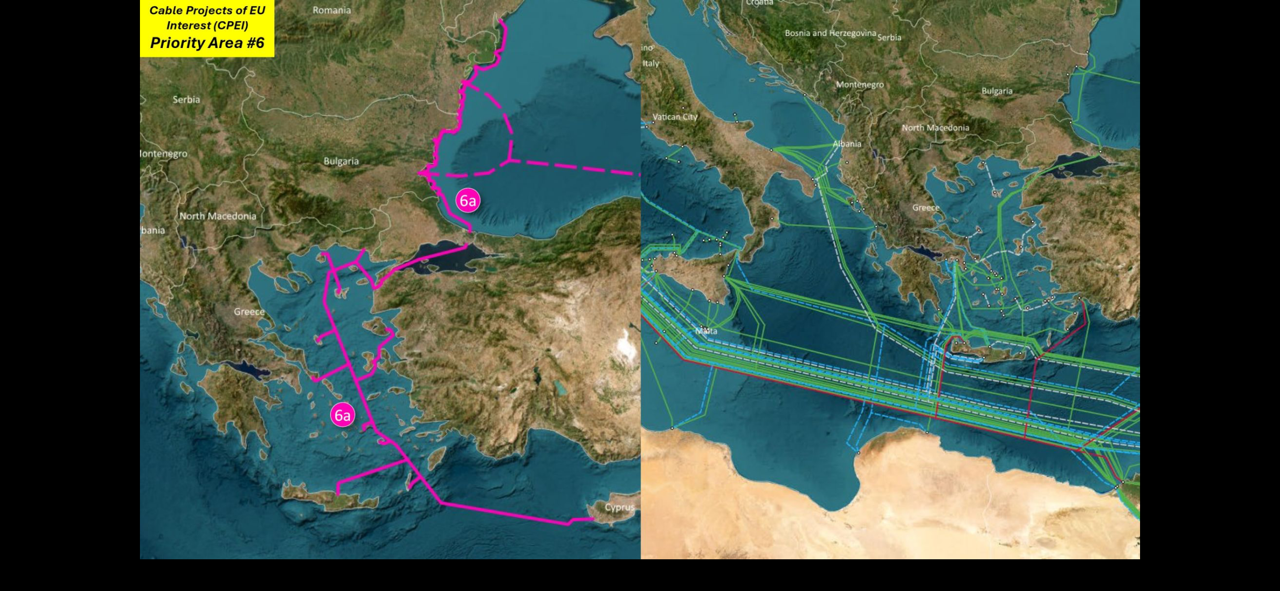
The area designated “Priority Area #6” under the Cable Projects of EU Interest (CPEI)—see the map at the end of the article—reveals an exceptional concentration of submarine cables converging toward a single restricted maritime space, bordered by Greece, Turkey, Cyprus, and Egypt, forming a digital hub with a density comparable to the world’s major crossroads. The blue, green, and red bundles crossing south of Crete are not abstract lines on a map: they are the arteries through which data circulates between Europe, Africa, the Middle East, and Asia.
Seventeen submarine cables cross the Persian Gulf, carrying by themselves 30% of global Internet traffic. Among them is the SMW5 (SeaMeWe-5), one of the world’s longest cable systems, linking Singapore to France via the Middle East. These two infrastructures cross or run precisely along the disputed maritime spaces of the Eastern Mediterranean before reaching their European landing points.
The European Union has grasped the scale of the issue. Its recent investment of more than €200 million in submarine cables and digital infrastructure in the region sends a clear political signal: connectivity is now treated at the same strategic level as energy corridors or trade routes.
The Strait of Hormuz and the Eastern Mediterranean share the same underlying logic. In both cases:
Geography concentrates flows. Straits, narrow passages, shallow seabeds close to coastlines—these physical constraints create chokepoints. A submarine cable route is not chosen in the same way as a road route: it follows bathymetry, optimal distances, and existing landing points. And these constraints mechanically create points of vulnerability.
Private actors carry public infrastructure. The AAE-1, SMW5, and FALCON cables are privately owned—by telecommunications consortia, and by major technology companies for the most recent ones. But their disruption would have immediate sovereign effects: paralysis of government communications, disorganization of financial markets, and rupture of allied military capabilities. This tension between private ownership and public utility lies at the heart of the governance challenge for submarine digital infrastructure.
The Eastern Mediterranean as a laboratory for European digital sovereignty
In this context, the CPEI Priority Area #6 initiative is far more than an investment program. It marks the beginning of a European doctrine of digital power through physical infrastructure — what I described in my initial article as the need to “map one’s dependencies as one maps one’s coastal vulnerabilities.”
Europe is learning, perhaps belatedly but resolutely, what maritime strategists have known for centuries: freedom of movement, whether maritime or digital, is not simply proclaimed. It is defended, financed, and organized in peacetime, before someone closes the strait.
What the Iranian threat really reveals
Iran’s decision to threaten maritime traffic and submarine cables simultaneously is, strategically, astute. It turns the Strait of Hormuz into what maritime strategists would call an integral chokepoint: a bottleneck that controls both physical flows—oil and goods—and immaterial flows—data, financial transactions, and communications.
This decision is all the more effective because it exploits the structural fragility of submarine cables. Around the world, submarine cables are regularly damaged—about 200 incidents per year—and repair vessels need authorization to enter a country’s waters. Yet only one repair vessel, owned by e-Marine, is currently located in the Gulf, considerably limiting repair options.
The Iranian position thus confirms that there is not, on one side, a maritime space with its own laws of power and, on the other, a digital space with its own rules. There is one and the same geopolitical space, where physical infrastructure and digital flows are inextricably linked. The two flows of wealth in the contemporary world pass through the same straits, rest on the same seabeds, and are exposed to the same vulnerabilities.
It recalls a broader reality: the foundations of the digital world are physical, concrete, and far from invulnerable.
In conclusion: three strategic priorities to address without delay
Map integral chokepoints
Hormuz is not alone. Bab el-Mandeb, the Strait of Malacca, the Suez Canal, the Luzon Strait in the South China Sea: these are all points where maritime flows and submarine cables overlap, creating cumulative vulnerabilities. Any serious digital power strategy must begin with this mapping.
Secure the repair chain
A single repair vessel in the entire Gulf: that is the current level of resilience. It appears far too low. The global fleet of cable-laying and maintenance vessels is undersized, poorly distributed geographically, and largely in the hands of private actors without a doctrine of public resilience. States must include these vessels in their thinking on strategic capabilities in times of crisis.
Think through an international law of submarine digital infrastructure
UNCLOS dates back to 1982, before the Internet, before fiber optics, before 10 trillion dollars in daily financial transactions began flowing beneath the oceans. The freedom to lay cables now coexists with the sovereign prerogatives of coastal States within a fragmented legal framework. A dedicated, binding international instrument is needed, with attribution and sanctions mechanisms.
The sea has always been the first territory of globalization. It is now also becoming the first territory of its digital fragility.