
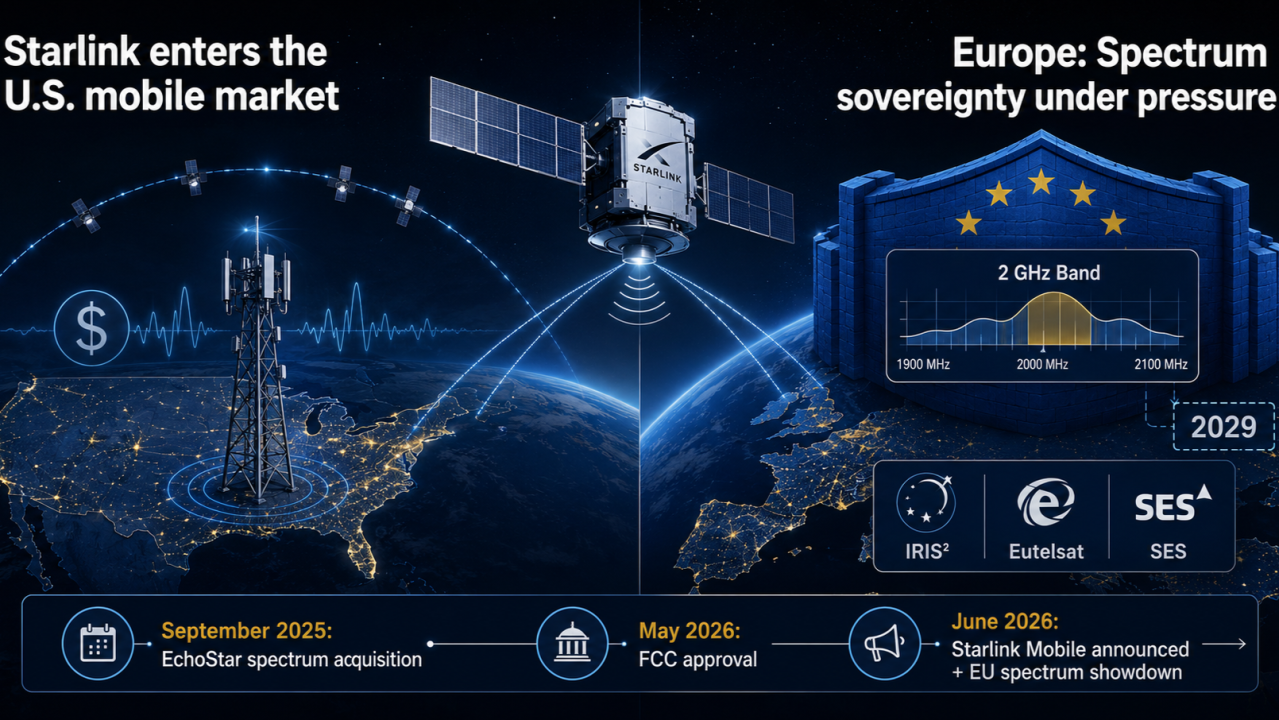
On June 26, 2026, the Financial Times revealed that Gwynne Shotwell, President of SpaceX, presented investors during the pre-IPO roadshow with a plan to launch a consumer mobile service in the United States.
At the same time, SpaceX sent the European Commission an aggressive white paper contesting its proposed framework for allocating 2 GHz band frequencies for satellite mobile services, going so far as to threaten to shut down its satellites over European territory if its demands were left unanswered.
The Mechanics of the Move: EchoStar as the Cornerstone
To understand Starlink's mobile ambitions, we need to go back to September 2025. SpaceX acquired from EchoStar 65 MHz of AWS-4 and H-Block spectrum licences for $17 billion, then unpaired AWS-3 licences for an additional $2.6 billion — totalling $19.6 billion in exclusive, nationwide mid-band spectrum, approved by the FCC on May 12, 2026.
What this acquisition fundamentally changes: before this transaction, Starlink had to use spectrum provided by its partner operators for its direct-to-cell service, making it entirely dependent on partnership agreements. That is no longer the case. According to SpaceX's own filing with the FCC, the next-generation D2D network enabled by this exclusive spectrum will deliver more than 100 times the capacity of SpaceX's first-generation system, targeting full 5G cellular connectivity comparable to current terrestrial LTE service, delivered from orbit to any standard smartphone. This is not an incremental improvement. It is a generational leap.
The target model is not that of a conventional mobile network operator. It is a hybrid architecture: LEO constellation + proprietary terrestrial spectrum + ground network to build or acquire. Starlink already generates $11.4 billion in revenue, $7.2 billion in EBITDA and $4.4 billion in operating income for fiscal year 2025. The financial foundations exist. The June 12, 2026 IPO raised nearly $86 billion and gave SpaceX access to capital markets to fund the rest.
One obstacle remains: the three major US operators publicly refused to sign an MVNO agreement with SpaceX, with the CEOs of AT&T and T-Mobile saying so explicitly during their Q1 2026 earnings calls. However, SpaceX has already identified a credible workaround. The company held executive-level talks with Charter Communications — the largest US home internet provider — about a consumer mobile phone partnership. Under the envisaged model, Charter would route SpaceX's phone traffic through its ground-based cable infrastructure, much as it does with its existing Spectrum Mobile offering. This path bypasses the Big Three entirely, while giving SpaceX the terrestrial infrastructure layer it currently lacks. Now that SpaceX owns its own mid-band licences across the entire US territory, the MVNO route is no longer an absolute necessity: a satellite-first offer marketed directly B2C, supplemented by Wi-Fi offload in dense areas, is a structurally viable alternative.
The European Front: A Spectrum War with Strategic Intent
On May 27, 2026, the European Commission presented a 2 GHz band sharing framework reserving two thirds of the spectrum for European operators — including a share for IRIS² and sovereign communications — and capping non-European players at a maximum block of 2×10 MHz each. The 2 GHz band is the only one harmonised across the EU for direct satellite mobile communications.
In response, SpaceX technically challenged the proposed allocation, arguing:
- that the bandwidth reserved for non-European players would be technically insufficient to offer very high-speed broadband;
- that this allocation would create cross-border interference, particularly between Poland and Ukraine, raising the risk of communication continuity failures in conflict zones.
But behind this technical argument, Elon Musk's company is actually seeking to trigger a far more direct confrontation with European institutions. SpaceX went as far as threatening to switch off its satellites as they pass over European territory if its demands are not met.
SpaceX's counter-offensive is backed by a firm stance from the US administration and its regulator, the FCC. Its chairman Brendan Carr warned that any discrimination against a US operator would trigger immediate and aggressive reciprocal measures, potentially excluding European companies — Inmarsat, Eutelsat — from the US market.
A First Test for Europe's Technological Sovereignty
The European Commission's May 27 decision is anything but naive. Thomas Regnier, the Commission's spokesperson for technological sovereignty, stated that satellite connectivity is a key element of the EU's technological sovereignty, security and defence. The decision to reserve the 2 GHz band fits within the logic of the Tech Sovereignty Package presented in early June 2026.
But the European position has a structural weakness: IRIS² will not be fully operational before 2030. That leaves several years during which the continent must manage a residual dependency on Starlink for critical communications — in Ukraine in particular — while closing the door to it on frequencies.
The EU itself acknowledges that restricting competition could limit innovation, even as it argues that protecting domestic operators strengthens resilience and public security. This is the classic paradox of industrial sovereignty policy: short-term and long-term imperatives are not aligned — and it takes political courage to prioritise the long horizon over immediate pressures. That is, in any case, the position the European Union has publicly taken in this matter.
What This Double Move Really Reveals
Continuing to view Starlink purely as a satellite connectivity provider would be an analytical mistake. What we have observed over the past twelve months is the methodical construction of a vertically integrated mobile operator on a planetary scale:
- An aggressive spectrum acquisition policy: $19.6 billion in terrestrial licences acquired in the United States, unlocking — per SpaceX's own FCC filing — a D2D capacity more than 100 times greater than the first generation.
- An unrivalled orbital infrastructure: over 10,000 LEO satellites deployed, representing approximately two thirds of all active satellites in orbit.
- A global customer base: commercial presence in 160 countries, $11.4 billion in annual revenue.
What SpaceX is seeking in Europe is not necessarily spectrum in the short term, but recognition as an indispensable global player in critical infrastructure — with government and defence contracts firmly in its sights. The white paper sent to Brussels is not an ordinary lobbying document. It is a statement of position in the broader geopolitical negotiation pitting the European Union's technological sovereignty ambitions against SpaceX's drive to consolidate its competitive advantage in a telecoms market being reshaped by the space segment.
Implications for the Key Players in Starlink's Double Offensive
The risk of Starlink Mobile as a direct competitor in their domestic market remains hypothetical in the short term — SpaceX has no terrestrial infrastructure in Europe and the regulatory framework is unfavourable to it. But the real danger lies elsewhere. Starlink has already established itself as the provider of last resort for rural coverage, relying on satellite roaming agreements with operators who believed they were in control of the relationship. This technical dependency creates a progressive asymmetry: the more European operators integrate Starlink into their residual coverage offer, the less incentive they have to see it excluded from the market, and the less independent their lobbying with regulators becomes. Today's 'partner' model can become tomorrow's 'competitor' model, on a unilateral decision by SpaceX. European operators have no credible exit clause until IRIS² is operational.
The 2 GHz band decision is an industrial policy choice whose structural effects will play out over twenty years. The precedent is well known: Europe missed the window on search engines, social networks, and cloud computing. It now finds itself legislating over platforms it does not control. Reserving the 2 GHz band for European players before they are in a position to make use of it is a short-term risk — but the only one that avoids long-term technological dependency.
Starlink Mobile fundamentally reconfigures the perimeter of the dependency threat. The question is no longer solely about the confidentiality of data transiting through US infrastructure — a problem already documented and partially addressed through sovereign encryption architectures. It becomes a question of service continuity itself. An emergency communications operator whose coverage partly relies on a LEO constellation controlled by a private US entity is exposed to three distinct risks: a unilateral commercial decision to modify pricing or technical conditions; political pressure exerted by a foreign government on that private operator; and vulnerability to cyberattacks or electronic warfare targeting a centralised infrastructure. The Ukrainian case demonstrated all three simultaneously: a SpaceX service restriction decision in February 2026 had immediate operational effects on the ground. For public buyers of critical communications systems — public safety, defence, crisis management — vendor risk assessment must now incorporate a geopolitical dimension that current procurement specifications have not yet consistently translated into operational criteria.
Nokia and Ericsson supply core and access network equipment to virtually all European operators, making them structurally dependent on a dominant terrestrial model. Starlink's emergence as a vertically integrated operator — with its own constellation, its own spectrum, and potentially its own terrestrial access network — represents a direct threat to their equipment sales model. According to Deloitte, cumulative global investment in LEO constellations and D2D satellites is expected to reach $10 billion by end-2026, signalling a profound market recomposition. Both Nordic vendors also have divisions dedicated to private networks and critical communications that could benefit from growing demand for sovereign alternatives to Starlink. But the systemic risk remains: if SpaceX succeeds in imposing an integrated satellite-terrestrial architecture that bypasses traditional equipment vendors — as it did in the space sector by internalising launcher manufacturing — the telecoms equipment market risks being permanently reduced in scope.
What is at stake with Starlink Mobile is the question of the communications networks underpinning command and control (C2) systems. Ukraine showed that battlefield informational superiority now partly rests on low-cost, high-resilience commercial communications infrastructure. It also showed that this dependency is a vector of strategic vulnerability: a private service restriction decision can have immediate operational effects on combat units. For European armed forces engaged in reflection on strategic autonomy, the question is not whether Starlink is a useful tool. It is. Several allied armies already depend on it. The question is at what level of dependency military C2 remains acceptable, and what hybrid architectures — combining sovereign capabilities with commercial supplementation — can preserve freedom of operational manoeuvre.
What Starlink Mobile Changes for Europe — and Why the Time for Declarations of Intent Is Over
What we observe in this double offensive is a planetary-scale vertical integration, conducted by a player that has already demonstrated its capacity to redefine the rules of the game in space, energy and transport.
Three Possible Scenarios for the Next Five Years
The first is negotiated dependency. Europe grants Starlink a share of the 2 GHz spectrum in exchange for service continuity and data localisation guarantees. IRIS² enters service around 2030, probably with delays, in a context where Starlink is already deeply embedded in civilian uses and some allied military applications. Europe buys time but loses structural ground. This is the most probable short-term scenario, because it is the least politically costly.
The second is deliberate break. Europe holds its line on the 2 GHz band, accelerates funding for IRIS², and accepts a period of commercial and diplomatic tension with Washington. This scenario requires political cohesion among member states that does not yet exist — the industrial interests of France, Germany, Italy and the Nordic countries diverge enough to undermine any common position once US pressure mounts. It is the most desirable scenario from a long-term sovereignty standpoint. It is also the hardest to sustain.
The third is recomposition through usage. SpaceX is not trying to convince regulators — it is trying to make regulation irrelevant by imposing itself as a de facto infrastructure. This is precisely what the Charter Communications discussions signal: SpaceX is building the consumer distribution layer it lacked, bypassing the operators that refused to partner, and advancing toward a critical mass of users that would make any spectrum exclusion largely theoretical. If that threshold is reached before IRIS² is operational, governments will find themselves negotiating not with a contender but with a systemic operator — in the same position they occupy today vis-à-vis the major cloud players. This scenario is the most dangerous because it requires no direct confrontation: it unfolds by default, in the gap between regulatory decision and effective implementation.
What This Dossier Reveals More Broadly
Beyond Starlink, what is at stake here marks the end of a sectoral regulatory model built on the assumption that dominant players operate in a single segment at a time: a telecoms operator, a satellite manufacturer, a launcher constructor. SpaceX is simultaneously all three, to which is now added the dimension of critical infrastructure provider for sovereign states in conflict situations. No existing regulatory framework — not the ITU's for spectrum, not the ARCEP's or BEREC's for telecoms, not the European Space Agency's for space access — was designed to regulate a player of this nature. It is this institutional void that SpaceX exploits, with a skill that owes as much to its technological power as to its ability to play simultaneously across multiple regulatory and diplomatic chessboards.
IRIS² at best in 2030. The 2 GHz band decision now. The gap between the two is not a given: it is a challenge of industrial execution and political will. France has understood this, pushing for a first low-orbit deployment as early as 2029. That is the right direction. But pushing is not enough. What is needed is a firm budgetary commitment at European scale, programme governance freed from the national industrial rivalries that have already cost Galileo years, and a clear decision on the prime contractor. Reserving the 2 GHz band without accelerating IRIS² is putting a lock on a door that has yet to be built. Sovereignty is not asserted in regulatory texts — it is deployed in orbit.